The Missing Link in World Models: AI Needs Causality, Not Just Observation
Astrocade
May 20th, 2026
Loading...
May 20th, 2026
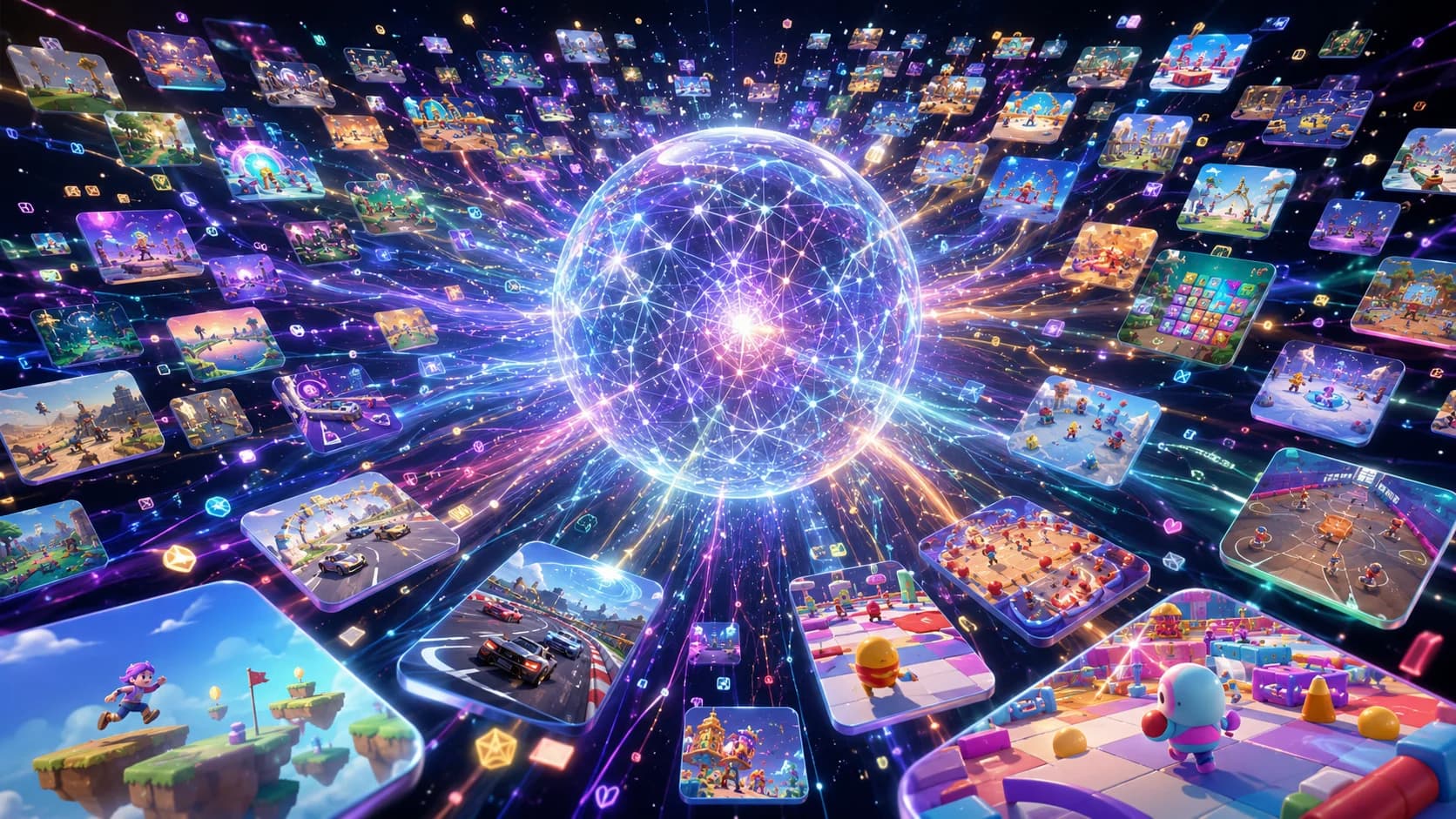
Every month, Astrocade users engage in over 140 million plays, diving into hundreds of thousands of games from a global community of creators. It's an incredibly diverse range of experiences, from simulations to action games to puzzles, to say nothing of the thousands of games that defy categorization altogether. And each presents a unique game world that players explore by tapping, swiping, running, jumping, collecting, merging, and so much else.
Sounds like we've achieved our goal, right? We've built a platform for playable content with tens of thousands of creators and millions of players. But we're not stopping here. All this player activity is great, but the real opportunity is what that activity makes possible. Because every day, that massive library of games (itself growing daily) is helping to train a world model of unprecedented scope and detail.
World models have been a hot topic in AI labs in recent years: systems that understand the physics and logic of reality with a depth and clarity current models don't, often trained by feeding them billions of hours of videos. It's an intriguing premise and the pursuit has yielded some impressive demos so far. But passive video has a fundamental limitation: it gives the model a sense of what happened, but not how — and certainly not why. An AI watching a video of a ball dropping may learn what a falling ball looks like, but it surely won't understand the causal mechanics of gravity, mass, or force.

This distinction matters, and recent examples have demonstrated it. WildWorld, for instance, is a training set that leverages gaming to combine both realistic visuals (footage of the gameplay) with detailed action annotations (the player's input and state of the game world at each moment), while Matrix-Game is a model trained on over a thousand hours of Minecraft game footage with precise keyboard and mouse data. Both have demonstrated that richer, more capable world models emerge when their training data includes explicit actions, structured state information, and aligned environment transitions. There's no questioning the power of this kind of data. But how can it be scaled?
Enter Astrocade, a platform built from the ground up that generates exactly this kind of data, across every genre of game and at a functionally limitless scale. Everything players do — every time they tap, swipe, jump, or merge, every point they score, and every time they die or retry — is part of a structured, precisely-annotated loop that connects observations and actions. We're not merely logging what appears to happen in games, but the actions the player took and how everything in the game world responded, from foundational facts like physics to the behavior of characters and objects. At scale, this becomes a powerful enabler for training action-conditioned world models: systems that do not merely watch actions unfold as an observer, but understand them from the inside, with innate understanding of what they mean in the context of a larger, physically-consistent environment.
Of course, even in the world of casual games, privacy is an essential part of training models at any scale. That's why, although comprehensive, our data logging is fully anonymized from end to end, focusing only on mechanical interactions and environment transitions — never the personal identity of our users.
We have a long-term vision for this data, but the most immediate application lives inside Astrocade itself, in the form of autonomous QA.
Because we have millions of human play sessions paired with environment transitions, we can train agents that learn not just what games look like, but how they are meant to be played. When a creator prompts a brand-new game into existence, those agents can immediately begin exploring it: testing movement, probing boundaries, checking win conditions and fail states, and identifying broken mechanics before the game reaches players.
Recent work on automated game testing already shows that gameplay logs can be used to learn formal action models for regression testing, and that AI agents can be useful testers even when they are not elite players. And once a system can reliably model how actions propagate through worlds, it can do more than test them. Over time, it can begin to generate and adapt them as well.
Of course, far more profound transformations await.
Projects like GameNGen, along with Google's Genie family of world models, suggest a future in which interactive environments are generated, directly by neural systems, rather than specified by traditional, hand-authored engines. These systems are still early, but they paint a compelling picture of a world in which experiences are rendered and evolved by models trained on sequences of actions and consequences.
Astrocade is unusually well-positioned for shifts like this. In fact, we're anticipating them. To us, the long-term opportunity isn't simply an AI-generated take on the games we already know, but a fundamentally new kind of game engine: one that can generate and adapt interactive worlds on the fly, shaped continuously by what the player does next.
As far as our players are concerned, Astrocade is just a place to have fun. And that's exactly how we like it. But under the hood, each of those players is contributing to something amazing with every move they make. The data our platform is curating, now at a global scale, is proving itself to be increasingly vital for training a new generation of predictive agents with spatial, physically-aware capabilities, and even paving the way towards AGI as a whole. And we're having fun while doing it.