



LESSON 8
Case Studies: Learning from Successful Games
5 min read
Intro
Congratulations on completing the Astrocade Academy curriculum! Each lesson so far has attempted to explain a technique or pattern found in successful games in the hopes that you can apply them to your own. Now, as a final exercise, let’s see how each of these techniques are found in the design of a real-world game with proven success.
Resource
The Astrocade Game Design Checklist

Click here
Before we begin, check out the Astrocade Game Design Checklist. This handy reference summarizes all the key features successful games tend to have, with links to the lessons that explore them, to help you quickly assess your own game’s quality during and after its creation.
Keep these bullets in mind as we explore the example game on the following pages, and don’t forget to keep it close by while working on your own creations!
A case study: A brilliantly-executed cozy cafe sim
Purr-fect Brew Cafe, from creator @dawn, is an excellent example of the popular restaurant management sim in the style of games like Pizza Ready.
It’s cute, easy to play, and accessible, and players clearly agree. The game climbed the charts quickly upon release, reaching the Players’ Choice category with a 1:16 median play time and an impressive proportion of play sessions in the 2-5 minute range.
Purr-fect Brew Cafe, from creator @dawn, is an excellent example of the popular restaurant management sim in the style of games like Pizza Ready.
It’s cute, easy to play, and accessible, and players clearly agree. The game climbed the charts quickly upon release, reaching the Players’ Choice category with a 1:16 median play time and an impressive proportion of play sessions in the 2-5 minute range.
FTUE and TTF
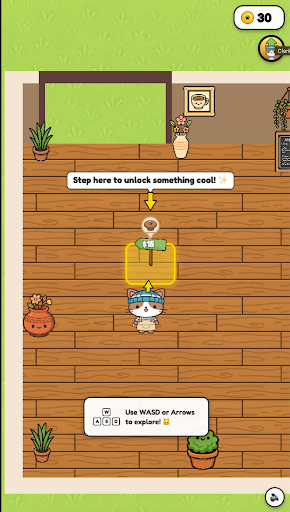
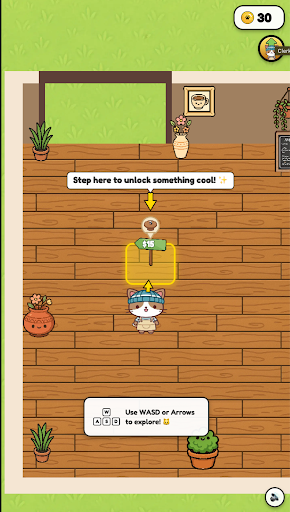
Great visuals, nicely integrated tutorials, and instant reward make for an excellent FTUE
The game has a more or less flawless FTUE, dropping players directly into the game world—no title screen, no menus, no distractions. Next comes a subtle take on the guaranteed win, with a glowing target area the player is instructed to enter. Doing so unlocks a table for seating customers.
This table could have simply been there automatically, but letting the player acquire it manually delivers an effortless jolt of accomplishment and reward. In a matter of seconds, players feel like they’ve achieved something.
Additionally, note that in-game tutorials are presented as the player plays, in context, rather than beforehand.
Great visuals, nicely integrated tutorials, and instant reward make for an excellent FTUE
The game has a more or less flawless FTUE, dropping players directly into the game world—no title screen, no menus, no distractions. Next comes a subtle take on the guaranteed win, with a glowing target area the player is instructed to enter. Doing so unlocks a table for seating customers.
This table could have simply been there automatically, but letting the player acquire it manually delivers an effortless jolt of accomplishment and reward. In a matter of seconds, players feel like they’ve achieved something.
Additionally, note that in-game tutorials are presented as the player plays, in context, rather than beforehand.
Core mechanic and juice
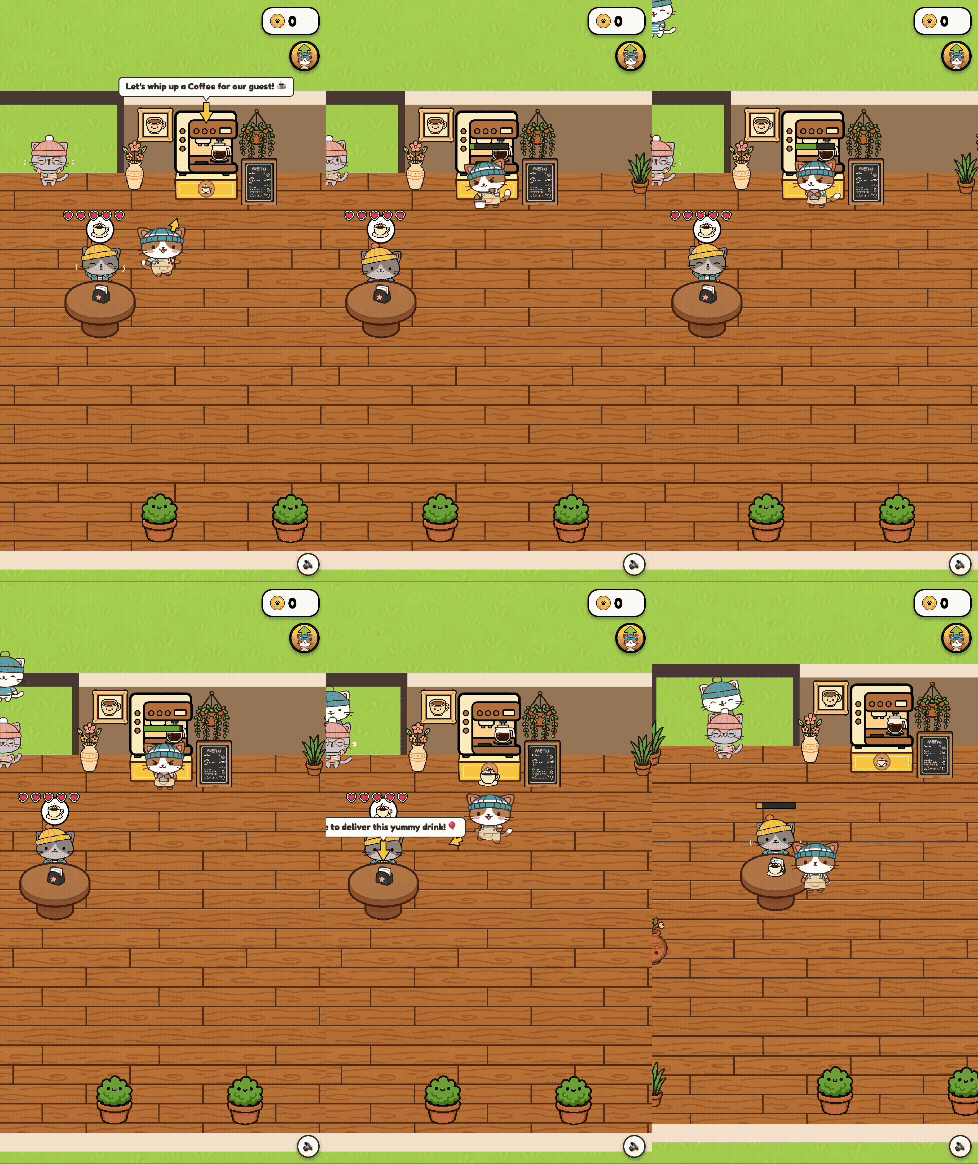
Animation adds a huge amount of realism and personality to otherwise simple actions
The game’s core mechanic is a restaurant management loop, in which the player must keep up with customer demand by serving drinks, collecting coins, cleaning up after customers leave, and repeating the process. Once learned, the player can repeat this process indefinitely, making for a very clean, clear core loop.
Numerous effects bring the experience to life, namely the excellent use of traditional animation. The player walks and idles naturally, and appears to work hard with a third dedicated animation for actions like brewing and cleaning. Customers are similarly expressive. The game wants to convey both cuteness and a kind of cartoon realism—real cats in a believable game world—and its effects do the job well.
Animation adds a huge amount of realism and personality to otherwise simple actions
The game’s core mechanic is a restaurant management loop, in which the player must keep up with customer demand by serving drinks, collecting coins, cleaning up after customers leave, and repeating the process. Once learned, the player can repeat this process indefinitely, making for a very clean, clear core loop.
Numerous effects bring the experience to life, namely the excellent use of traditional animation. The player walks and idles naturally, and appears to work hard with a third dedicated animation for actions like brewing and cleaning. Customers are similarly expressive. The game wants to convey both cuteness and a kind of cartoon realism—real cats in a believable game world—and its effects do the job well.
Meta loop and progression
Animation adds a huge amount of realism and personality to otherwise simple actions
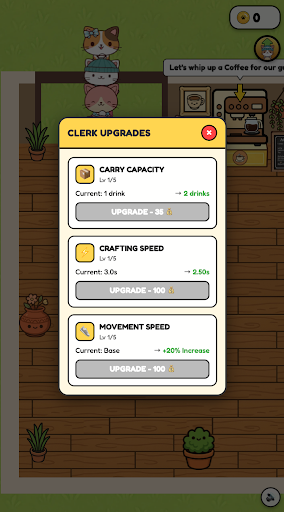
The game follows the standard progression pattern for games of this type, with the player incrementally unlocking new tables, new machines (which, in turn, allow the customers to order more items), and a collection of purchased upgrades.
Upgrades roughly follow the standard progression of a consistent, linear boost to the stat itself (such as a reduction in time taken to brew a drink, or the total number of items the player can carry at once), paired with a roughly exponential rise in upgrade cost at each level, with a max of 5.
Animation adds a huge amount of realism and personality to otherwise simple actions
The game follows the standard progression pattern for games of this type, with the player incrementally unlocking new tables, new machines (which, in turn, allow the customers to order more items), and a collection of purchased upgrades.
Upgrades roughly follow the standard progression of a consistent, linear boost to the stat itself (such as a reduction in time taken to brew a drink, or the total number of items the player can carry at once), paired with a roughly exponential rise in upgrade cost at each level, with a max of 5.
Download times
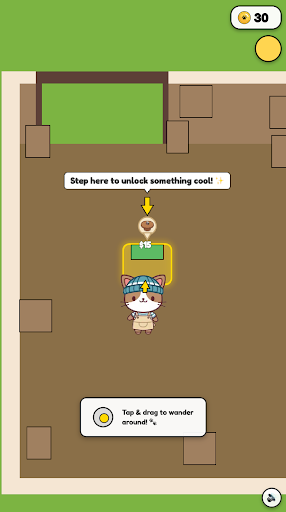
Most of the game’s visuals are lazy loaded, but its simple art style allows the placeholders to blend in reasonably well during those few awkward seconds
Finally, the game downloads amazingly fast, reaching a playable state in under two seconds at our standard testing rate of 3000 kbps and 150 ms latency.
A simple loading screen covers whatever wait times the player experiences, and while it’s plain, the game appears fast enough that it’s unlikely to cause any loss in interest.
Crucially, lazy loading is used to great effect as well; much of the visuals, including the grass background and cafe wall/floor elements, appear as solid-colored placeholders while they load. Even character animation loads later, with static characters serving as stand-ins for the first few seconds.
Most of the game’s visuals are lazy loaded, but its simple art style allows the placeholders to blend in reasonably well during those few awkward seconds
Finally, the game downloads amazingly fast, reaching a playable state in under two seconds at our standard testing rate of 3000 kbps and 150 ms latency.
A simple loading screen covers whatever wait times the player experiences, and while it’s plain, the game appears fast enough that it’s unlikely to cause any loss in interest.
Crucially, lazy loading is used to great effect as well; much of the visuals, including the grass background and cafe wall/floor elements, appear as solid-colored placeholders while they load. Even character animation loads later, with static characters serving as stand-ins for the first few seconds.
Conclusion
All in all, Purr-fect Brew Cafe is a textbook case study in how the principles of Astro Academy can lead to a runaway success. Virtually every recommended practice is found here in some form or another, from the proven game mechanic at its core to the cute, thoughtfully designed details and progression loop.

Onward, cadet! To the exercises!
Exercise
The Astrocade Game Design Checklist
Click here
Using the Astrocade Game Design Checklist as a reference, perform your own analysis of an Astrocade game from the Players’ Choice category. These are our highest-performing games, and while they don’t all follow our recommended guidelines precisely—remember, these are guidelines, not black and white rules—they correlate closely enough.
By learning to identify the use of these techniques in the games you play, you’ll help solidify them in your own thinking as a creator.