



LESSON 5
Turning a Core Mechanic into a Complete Game
8 min read
Intro
We’ve made a big deal out of the importance of your game’s core action, and for good reason. But even casual games need to offer the player more in order to ensure they keep playing (and hopefully come back for more!). Once the core of your game has been proven via testing to be fun and compelling (and no sooner!) it’s time to start thinking about extra features.
The core loop vs. the meta loop
Most games can be thought of as two ongoing loops: the core loop and the meta loop.
The core loop
The core game mechanic we’ve already spent so much time discussing. It’s what the player is doing from one moment to the next, whether that’s driving a car, collecting coins, breaking blocks, growing vegetables, or whatever.The meta loop
Sometimes just called “the meta”, this is what unfolds over time as a result of the core loop. For instance, those coins the player collects (core) might enable an upgrade shop or cosmetic unlocks (meta), while growing and selling vegetables (core) might help the player achieve farm upgrades or acquire new seeds (meta).These loops are often visualized as one inside the other: the core loop, as its name suggests, is “inside” the meta loop; the core loop is a fast, tightly repeating pattern, while the meta loop is more gradual, unfolding over time.
Core loop examples
A game’s core loop is essentially the core game mechanic we already understand, fleshed out into a complete experience that encourages the player to repeat the process in a satisfying way. And at the risk of repeating myself ad nauseum: if your core loop isn’t fun, your game is cooked!
First-Person Shooter (e.g., Call of Duty)
Spot enemy → Aim → Shoot → Reload → Reposition
Action RPG (e.g., Diablo)
Find monster → Attack → Kill → Collect dropped loot
Farming Sim (e.g., Stardew Valley)
Plant seeds → Water crops → Harvest → Sell
Action Roguelike (e.g., Hades)
Enter a room → Defeat a wave of enemies → Choose a temporary power-up → Proceed to the next room
Meta loop examples
If the core loop is what you do, the meta loop is why you keep doing it. Also known as the progression system, the meta loop operates on a longer timescale. It gives context and meaning to the repetitive actions of the core loop.
First-Person Shooter (e.g., Call of Duty)
Earn experience points from matches → Level up profile → Unlock new weapons and attachments → Equip them to perform better in the next match
Action RPG (e.g., Diablo)
Use collected loot to craft better armor → Face harder bosses → Uncover the next chapter of the story
Farming Sim (e.g., Stardew Valley)
Use money from sold crops to buy better tools → Clear more land → Build automated sprinklers → Expand the farm's total output
Action Roguelike (e.g., Hades)
Eventually die and lose all temporary power-ups → Return to the hub area → Spend permanent currency (earned during the run) on permanent stat upgrades, new weapons, or story progression → Start a new run with a baseline increase in power
How the core loop and meta loop work together.
A well-designed game plays these loops off each other in a balanced, complementary way:
- The player engages in the Core Loop to earn resources, be they XP, gold, crops, materials, high scores, or whatever else.
- The meta loop then allows the player to use or apply those resources in a way that achieves a broader goal, upgrade, or unlock.
- The meta loop then feeds back into the Core Loop by altering it—giving the player a new weapon to shoot, a new area to explore, or a faster way to harvest.
Progression: Designing your game's meta loop
Casual games generally progress through some combination of the following:
- Progressive difficulty: Most obviously, games gradually get more challenging over time.
- Progressive complexity: Complexity is related to difficulty but distinct; games may also choose to give the player more to do as they advance: more tasks to manage, more variables to keep track of, and so on.
- Progressive variety: The content of the game should change as well, whether it’s new environments, new enemies, new hazards, new items and power ups, and so on.
- Progressive purchase/upgrade opportunity: Most genres of games include some kind of currency (coins, gems, resources, etc.), allowing the player to unlock bigger and better upgrades, customization options, and other rewards as they advance.
First things first: The guaranteed win
Casual game designers often start their game with a guaranteed win—an instance of the core game mechanic or action (breaking blocks, matching colors, defeating an enemy, etc.) so easy it’s impossible to fail.
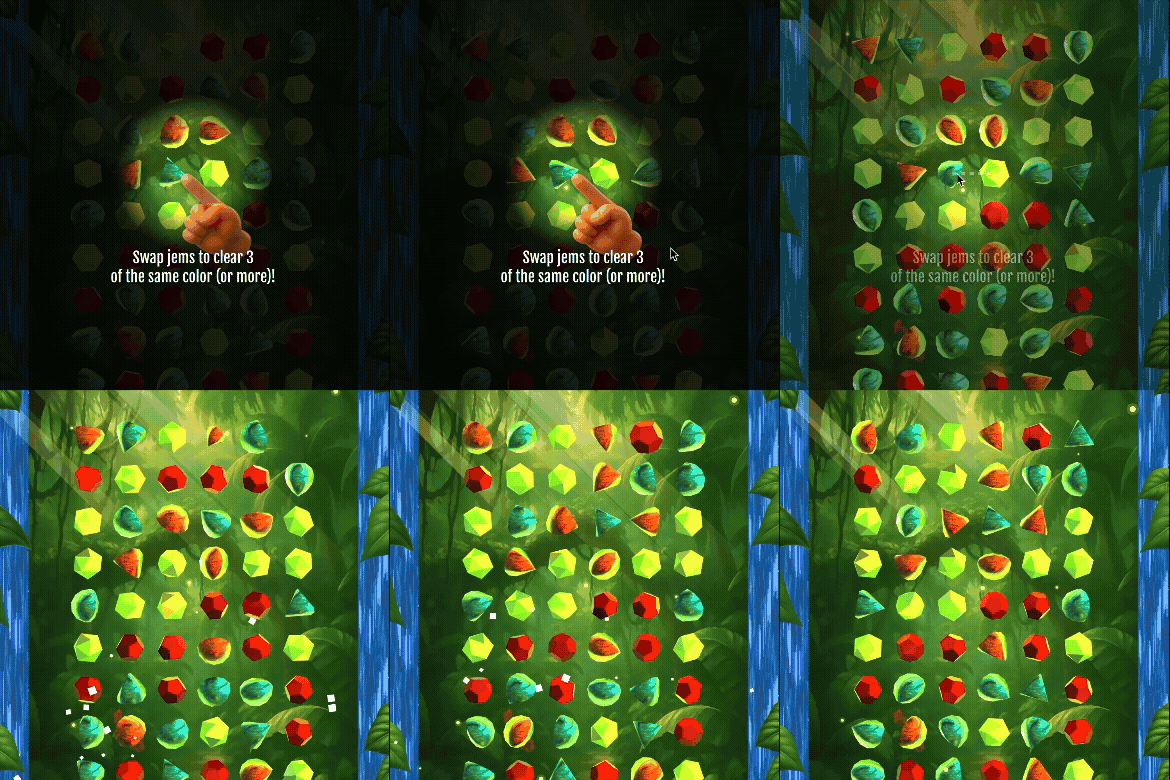
This match 3 game highlights the first matching row of gems as both a guaranteed win and a tutorial
The guaranteed win achieves two things:
- Good vibes: Starts the game off on a positive note—no matter how easy, everyone feels good when their first attempt at something is successful.
- Instruction: Helps with onboarding, as a guaranteed win is a hands-on tutorial, demonstrating how the game is played in a fun way.
This match 3 game highlights the first matching row of gems as both a guaranteed win and a tutorial
The guaranteed win achieves two things:
- Good vibes: Starts the game off on a positive note—no matter how easy, everyone feels good when their first attempt at something is successful.
- Instruction: Helps with onboarding, as a guaranteed win is a hands-on tutorial, demonstrating how the game is played in a fun way.
Progression tips: Difficulty level
Casual game difficulty generally does not increase in a simple, linear way, as continual increases are likely to cause player fatigue and frustration. Instead, they typically follow a “sawtooth” pattern in which increases in difficulty are immediately followed by “cooldown” levels that offer the player some relief and preserve the player’s feeling of competence.
“Sawtooth” refers to the jagged shape of the difficulty curve, resembling the up-and-down pattern of teeth on a saw
Progression tips: Content variety
Unlike progressive difficulty, content variety (visuals, characters, etc.) can usually be handled in a simpler way. If you have four different level backgrounds, for instance, rotating them in an even, linear cycle is usually best. Here’s how the linear progression of visuals contrasts with the standard sawtooth difficulty progression:
Progression tips: Upgrades and boosts
How should progression of upgrades and boosts be handled as the player advances?
If your game offers upgrades (especially level-based upgrades, as found in an upgrade shop), consider this standard structure:
- Players can stack upgrades until a maximum cap is reached.
- Each upgrade boosts a stat linearly, adding a fixed percentage of the base value—meaning, the original value. This prevents runaway stat explosions (OP) that throw off the game’s balance.
- Upgrade costs scale exponentially (significantly faster than stat growth) to create economic friction, making each subsequent upgrade noticeably harder to achieve.
Here's a practical example for a server speed upgrade in a restaurant management game. First, let's define the player's base speed, the rate at which their speed increases, the rate at which the cost of those upgrades scales, and the maximum number of upgrades:
Base player speed
Speed stat scaling
Cost scaling
Max cap
100%
+10% of base speed per upgrade (linear)
1.5× multiplier per upgrade (exponential)
5 upgrades
And here's how the player's speed changes as the player progresses:
Upgrade level
Server speed
Upgrade cost
Progression
Base (Level 0)
100%
100
Starting state
Level 1
110%
150
Speed +10%, Cost ×1.5
Level 2
120%
225
Speed +10%, Cost ×1.5
Level 3
130%
338
Speed +10%, Cost ×1.5
Level 4
140%
506
Speed +10%, Cost ×1.5
Level 5 (Max)
150%
(None)
Cap reached
Progression summary
In summary, here’s a tested strategy for game progression applicable in almost any genre:
- A guaranteed win: Start your game by handing the player an easy, can’t-miss victory that ensures a fun, encouraging first experience.
- Sawtooth difficulty progression: Balance challenge with player fatigue by following increases in difficulty with brief cooldowns that keep them on their toes without overwhelming or frustrating them.
- Progress visuals linearly: Keep visual progression simple, with a linear cycle of things like level backdrops, music changes, and so on.
- Upgrade boosts grow linearly while costs grow exponentially: Each upgrade boosts the player’s stat in a uniform, linear way, while the costs grow exponentially to keep the challenge fresh.

Onward, cadet! To the exercises!
Exercise
Define your core and meta!

Click here
Our GDD expands yet again with an overview of our game’s core loop and meta loops. Using what you learned in this chapter, describe how your game’s core mechanic functions as a core loop (the thing the player does from moment to moment), then decide on the meta loop that surrounds it (the larger picture that gives the core loop purpose and meaning).
Finally, as a simple first step towards designing that meta loop, come up with a guaranteed win you can give the player as soon as the game starts.
For now, don’t worry about implementing any of this. This is an exercise in planning only.
Quiz
Lesson Recap
Click here
Finally, to complete this lesson, check out the linked form for a simple recap quiz that tests your knowledge of this lesson’s most important concepts.
Don’t worry, it’s easy (and open book 👀)!